Green Garden
Chasing SunlightGreen Garden is an occult location in the eastern world, known through maps and esoteric knowledge rather than ordinary geography. By the time the Endeavor leaves Beacon again, Eleanor treats it as a destination that cannot be reached by conventional navigation: she says that only occult maps can lead to places that do not exist, and identifies her growing understanding of Green Garden as the means by which she may locate it herself. The evidence does not describe the garden’s appearance or record its arrival, but establishes its importance as a hidden place whose existence depends on knowledge that exceeds ordinary charts.
Definition and Elusive Geography
Green Garden belongs to the class of eastern places that resist the assumptions of human civilization. Eleanor distinguishes it from destinations that can simply be marked and approached by a ship. The ordinary maps inherited from the Endeavor’s earlier journey are already among the most comprehensive maps of the east available, yet they are insufficient for this purpose. Green Garden therefore represents a limit within exploration itself: the problem is not merely distance, but the failure of ordinary cartography to describe a place that does not exist within familiar geographical rules.
Its inaccessibility is reinforced by the changing political and occult conditions of the east. Eleanor and Captain Montgomery discuss Ukaresh as a destination that is now far enough away, especially because it can no longer be reached by the previous route. Against that loss of access, Green Garden appears as a different kind of possibility. It is not presented as a stable port or known settlement, but as a place that may be recovered through occult means when conventional routes have failed.
Eleanor’s Knowledge and Intended Search
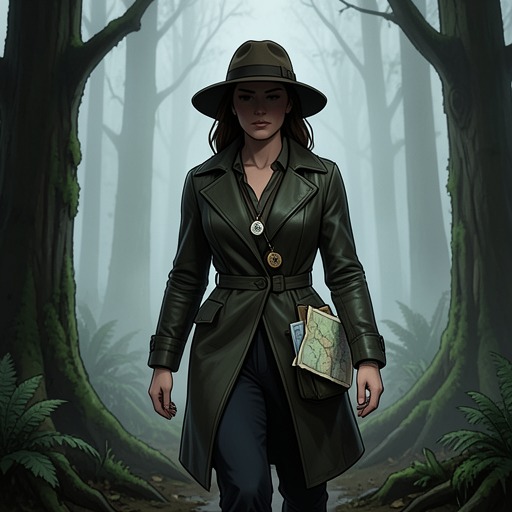
Eleanor is the character most directly associated with Green Garden in the available evidence. On the Endeavor’s bridge, she explains that she has acquired maps through both legitimate and illegitimate methods, placing those maps beside the charts inherited from the ship’s previous expedition. The new collection is not merely practical equipment: it is an attempt to assemble the hidden geography required for a journey beyond recognized space.
Her confidence rests on more than possession of the maps. Eleanor says that, now that she truly understands Green Garden, she should be able to find it once the Endeavor comes near enough. This statement changes the nature of the expedition. The crew is not simply following a route discovered by another explorer; Eleanor expects to interpret the occult maps herself and convert forbidden or incomplete knowledge into navigation. Her intended role is consequently part navigator, part interpreter, and part claimant of a place that ordinary institutions cannot securely possess.
The distinction between understanding and finding is important. Eleanor does not claim that Green Garden has already been reached or that its position has become ordinary knowledge. She presents comprehension as a necessary condition for discovery, while leaving the actual search ahead. The garden remains suspended between destination and revelation, its location dependent on whether Eleanor’s knowledge can withstand the eastern world’s resistance to human maps.
The Eastern Expedition and Wider Context
The renewed voyage begins in Beacon after the aftermath of the Endeavor’s previous return has been absorbed into public gossip. The period is informally called the Winter of Blood by some observers and the Winter of the Shadow by others, although the competing labels are treated with some mockery. Against that unsettled background, Captain Montgomery prepares the Endeavor for another expedition, and Eleanor boards with Sarah and Marie, who remain within her orbit even though they no longer present themselves as maids.
The departure is deliberately described as less auspicious than the previous one. Montgomery, remembering what happened on the earlier expedition, is content with a quieter beginning, while Eleanor frames the journey as comparatively limited because the ship will not travel as far as before. Yet the destination she names, Ukaresh, is already beyond ordinary reach, and Green Garden introduces a still more radical objective: a place accessible only through occult maps. The contrast gives the new voyage an ambiguous scale. Its beginning appears modest, but its intended geography extends beyond the boundaries that previously defined exploration.
The broader eastern world has already shown why such a search cannot be treated as routine travel. The Endeavor’s earlier journey encountered glacilium, mountain-sized ice beings whose migration brought blizzards over Beacon and whose glaciwings attacked the city; the ship crossed a metal gate into a district where the influence of nonhuman forces distorted buildings and inhabitants; and it met a caraveneer whose enormous luminous tail extended thirty or forty feet behind its body. The crew also witnessed the immediate, violent feeding of a slain beast by the caravaneers. These episodes establish an environment in which human categories of landscape, society, and danger are inadequate. Green Garden’s occult cartography is therefore consistent with an east where geography is inseparable from nonhuman agency and unstable forms of knowledge.
Narrative Significance
Green Garden functions as a threshold between exploration and occult revelation. Earlier journeys depend on charts, resources, repairs, and known stopping places, including the raw terrestrite needed to distill zint fuel. Eleanor’s proposed search depends instead on maps that can reach destinations outside ordinary existence. The shift makes the garden a test of whether knowledge can create access or whether the east will continue to evade the forms by which human explorers attempt to master it.
The location also concentrates the book’s recurring tension between discovery and possession. Eleanor has obtained maps by mixed means and now believes that understanding Green Garden will allow her to find it independently. Her confidence suggests a movement away from inherited authority: she is no longer relying solely on charts made by earlier expeditions or on the established routes of Beacon. At the same time, the garden’s status as an occult place prevents that confidence from becoming simple mastery. The available narrative ends with the Endeavor heading east, Eleanor affirming the direction while looking into darkness; Green Garden remains an intended destination, not a completed discovery.
In that unfinished form, Green Garden embodies the promise and danger of the eastern expedition. It is a place that cannot be reached by merely going east, because its position lies beyond ordinary maps and perhaps beyond ordinary existence. Eleanor’s claim to understand it gives the journey a concrete objective, but the absence of a depicted arrival preserves the garden as an open horizon: a location defined as much by the limits of human knowledge as by any confirmed physical site.